Immersive technologies are transforming dentistry by enhancing education and patient care. Augmented reality enables the overlay of holographic data onto the real world, meanwhile virtual reality creates safe, risk-free environments, suited for practice. Despite significant advancements in surgical and implant dentistry, these technologies continue to evolve, promising even greater improvements in dental outcomes and training in the coming years.
Important notice regarding surgical planning and professional clinical use
Specialized functionalities for surgical planning and pre-operative professional applications are exclusive to Medical Imaging XR PRO FDA. This version is not yet available. Information about the release date will be published here soon.
Medicalholodeck is currently undergoing the required FDA (U.S. Food and Drug Administration) and CE (Conformité Européenne) certification processes. Our team is working diligently to ensure full compliance with all regulatory standards, and we expect Medical Imaging XR PRO to be available in both the United States and the European Union soon.
For updates on product releases, regulatory progress, and availability, or for any related inquiries, please contact info@medicalholodeck.com.
VR-based simulators can provide qualitative feedback, and therefore enhance surgical precision. A patient with a persistent periapical lesion unresponsive to conventional root canal treatment required endodontic microsurgery. CBCT data were segmented to create STL models of the tooth, root, and surrounding bone, which were then imported into a VR haptic simulator. A resident surgeon practiced the full surgical workflow, which entailed accessing bone window, root-end resection, and ultrasonic retro preparation, until reaching a predefined performance threshold. The subsequent procedure was carried out successfully under supervision, and one-year follow-up imaging confirmed complete healing.
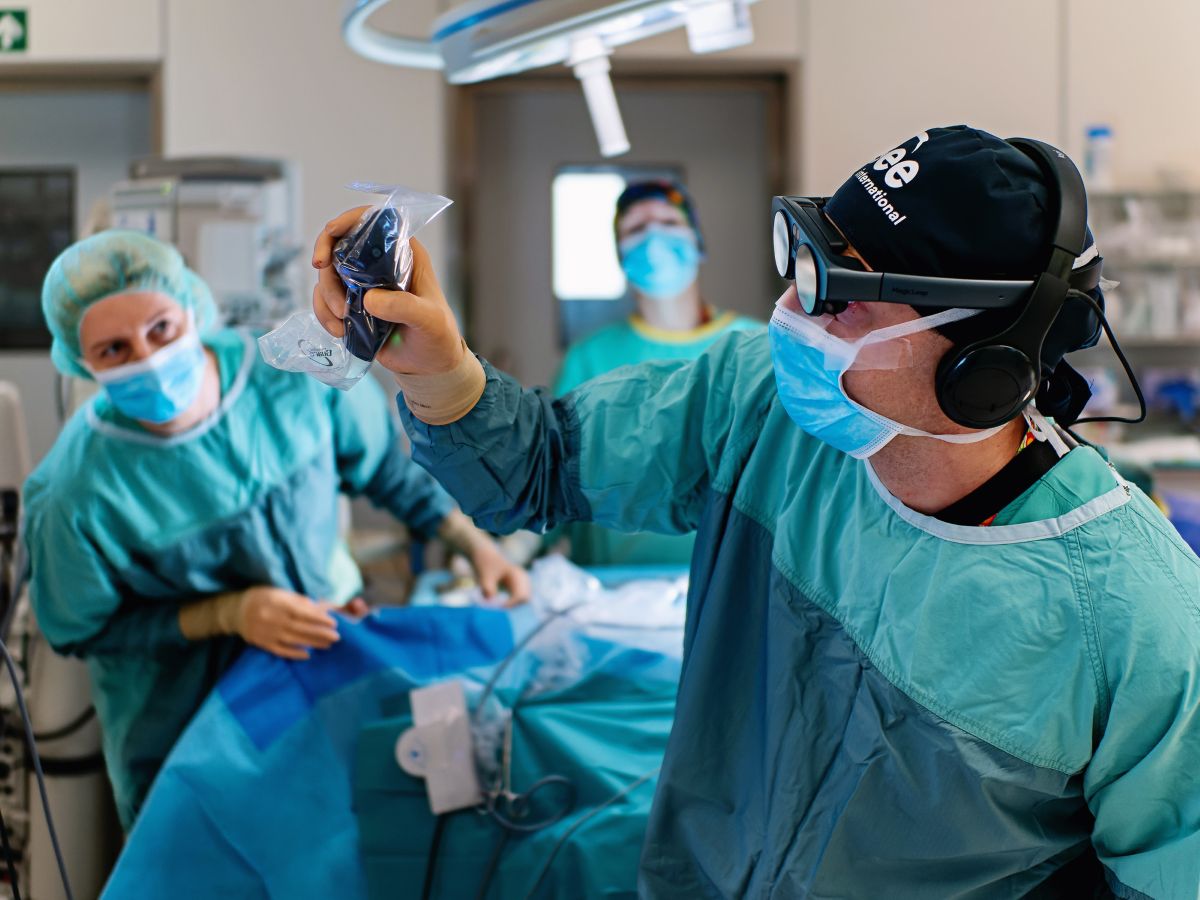
Mandibular-third molar extraction, also known as wisdom tooth removal, is a common yet complex dentoalveolar surgery due to positioning of structures such as roots or nerves. During the procedure, using a Magic Leap 2 headset, a surgeon viewed an AR-based overlay of the patient’s data. The holographic projection highlighted the tooth crown, mucoperiosteal flap outline, and inferior alveolar canal, allowing for precise planned osteotomy and odontotomy. Post-op, the patient reported low pain, uneventful soft tissue healing, and preserved nerve sensation.
Dental implant surgery entails the need for high-level precision to achieve functional and aesthetic results. Traditional guidance methods are often expensive and rely on specialized hardware. However, the AR technology, already impacting the dentistry field, can be accessed via regular, consumer smartphones.
This allowed for introduction of a cost-effective prototype AR system for real-time navigation. A smartphone camera served as an AR platform, which could overlay a 3D dental model detailed with planned implant position onto a training physical model. In vitro testing supported the system’s usability, maintaining precise overlay registration and aiding accurate drill trajectory.
AR-assisted intraoral scanning is showing promise as a viable alternative to conventional scanning techniques. Ten patients underwent two scans of the mandibular arch. During the traditional scans, using Confocal Laser Scanning Technology, the operator had to continuously shift their gaze between the patient's mouth and the computer screen. In the AR-assisted scans, the operator wore an AR headset that projected the scanning feedback directly in their field of view. This resulted in reduced scanning time while maintaining a similar level of accuracy, as no significant differences between the two methods were observed.
The popularity of virtual and augmented reality in dental education is constantly growing. While these technologies allow students to develop their spatial understanding and practice motor abilities before interacting with patients, standard mannequin simulations don't fully reflect clinical cases.
AI-enabled VR systems tackle this issue by simulating realistic dental scenarios, allowing students to gain practical experience. Furthermore, AI-driven algorithms can monitor students' actions in real time, offering immediate feedback and guidance to raise training efficiency.
VR and AR allow dentists to practice procedures in risk-free environments, guide surgeries with real-time overlays, and streamline workflows such as intraoral scanning and implant placement. Combined with AI, these tools offer realistic simulations, personalized feedback, and enhanced skill development, improving the safety and efficiency of dental care.
Medicalholodeck integrates with secure hospital systems, providing PACS access, HIPAA-compliant data handling, and full patient data security. It runs on stereoscopic 3D displays, VR headsets, mobile devices, and standard Windows systems, enabling flexible use in hospitals, classrooms, and training centers.
Specialized features for surgical planning are exclusive to Medical Imaging XR PRO. Currently, Medicalholodeck is available only for educational use. The platform is undergoing FDA and CE certification, and we expect Medical Imaging XR PRO to be available soon in the U.S. and EU markets.
For updates, regulatory news, availability, or questions contact info@medicalholodeck.com.